Showing posts with label melee. Show all posts

Tuesday, September 21, 2010

Tactical Tuesday: The Sling Blade

Sometimes things are just serendipitous.

Large vocabulary aside, I was watching a horribly depressing film starring Billy Bob Thornton on STARZ this afternoon when I got home from school and was struck by the simple fact that I had no idea why the movie was called "Sling Blade." Until later in the movie that is. And then my topic (like the sling blade to Billy's mama in the movie) hit me like a ton of bricks.

Which brings me to our topic today:

Ladies and Gentlemen:

The Sling Blade
AKA: Brush Hook, Kaiser Blade, Bush Hook or Ditch Bank Blade
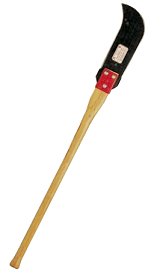

Ditch Bank Blade
Sling Blade


The tool is meant to be used by a standing individual in order to clear brush or grass low to the ground in an area like a ditch or rocky outcropping where a mower would be unpractical. My dad always used ours (oh. apparently we have one. don't mess with me) to trim crab grass in our front yard. That of course was before age 50 set in and the present tradition of using an electric hedger came into vogue (along with the lazy).  As you've noticed I have listed additional names for this tool/weapon I did this because this tool comes in a plethora of different styles. I picked the one that l liked best (and the one I'd seen before in our garage, quietly rusting).  Try googling any of the other names listed and see what pops up if you are so inclined. Anywho.

As you can see by the design of the tool, it is very similar in design to an ax--in fact the handle is an ax handle. The blade itself is sharp on the outside and inside of the curve. The point is not meant for stabbing but instead better facilitates the slicing motion used to slice at scrub brush. OR ZOMBIE FLESH! The blade is made of steel coated in some poly-plastic covering to help prevent rust and chips.
Scimitar: Big Fat Curve

The reason I like this tool as a zombie weapon is because of that curve.  Stabbing weapons don't have curves like the Roman Gladius or the French Rapier.  Even the Scottish Claymore or English Hand and a Half sword are more meant for hacking/chopping. Curved weapons are meant to slice. I like slicing because if the blade is sharp enough, it requires the least amount of work. It's why Katanas and Scimitars are curved: their intent is to slice through whatever they hit.

Gladius: no curve


That curve makes the metal of the tool move fast in whatever direction the blade is moving. It also helps cut through the substance its going through so that when the rest of the blade comes through there is less resistance. It makes the motion of slicing more natural and easy on the slicer.

Hand and Half Sword: No Curve


Katana: Slight Curve


Also, since the tool is meant to be used by a person standing up the handle is long enough to be used in a slicing motion to a ghoul a few steps away---but can be short hefted to slash at a zombie close up.

BWAHAHA.

I also really like how easily obtainable and cheap this tool is. I found one in walmart for like 50 bucks. Certainly can't buy a hardy sword for that cheap.

 
I really like weapons that double as tools because it just means one less thing my lazy butt has to carry. Weapons that don't require a ton of maintenance and training to use are also a plus. I don't really need a ton of aim to slice the top of a zombie's head off with a sling blade. In theory.
Tee hee.
Anyway. Raid walmart. Do it.
 
Practical--er use
 
Practical Use

As a side note, good people. Could I have some suggestions? Send me Gun and melee weapon suggestions!! OR questions about first aide. Or something! I need research topics!!!
I heart you, you zombie fanatics you.


Tuesday, August 10, 2010

Tactical Tuesday: The Katara

Short Katar
Tactical Tuesday #9

I'm in the mood for steel. So forgive me as I suggest a slightly ridiculous but nonetheless effective weapon one could rely on in the event of a zombie apocalypse. I am a big fan of melee weapons because I personally enjoy the idea of a weapon with as few moving parts as possible, since it generally means less maintenance and less margin for error (lose a screw out of a gun and you're screwed--hah).

Ladies and Gentlemen: the Katara.

Three-Bladed Katar=not good zombie weapon
The weapon is Southern Indian in origin and is meant for fast and close quarters combat. The weapon is designed as a short stabbing weapon to be used against armored assailants. The blades themselves can range in length and width--some Kataras were created from the fusion of a European blade and an Indian blade. Generally, the weapon has a broad double edged blade with a raised center line extending from the point, creating a sharp, broad point.  The blade can be as short as a few inches or as long as a few feet.  Some Katars are designed to open into three seperate blades (as popularized on SpikeTV's Deadliest Warrior). While an effective disemboweling device, this would be useless against a foe whose bowels are probably dragging the floor already.

Notice the horizontal grip with the wrist strap
What drew my attention about this weapon was the design of the handle and sideguards.  The handle effectively makes the weapon an extension of the user's hand. This would make the most common strike a forward, upward or straight punch out, which requires very little skill and only moderate effort (especially considering that when I'm scared or startled my first instinct is to lash out). The other interesting design aspect is the longish side guards available on some blades. These have their benefits and their problems. These guards could possibly provide decet protection from a bite when striking a ghoul, since the real danger with melee weapons is the "up close and person" fighting. That being said, the longer styles (some almost as long as the blade itself) can be garishly clumsy and difficult to carry. Thus if one is interested in utilizing this weapon as an effective anti-zombie device I would recommend a weapon with a 8 inch blade and a 6 inch handle--making the overall weapon a little over a foot. This would make the weapon right around managable to be carried on the belt and easily withdrawable in the advent of sudden attack.
This would be an optimum Katar in zombie defense

The only real downside to this weapon is its rarity in the United States, but never fear that is changing. With its appearance on the television recently the popularity of the Katar is growing, which means it may soon be as common in hobby and collectible shops as the Katana or Broadsword. So I feel while slightly silly the Katar could reasonably be something to consider when planning your end of the world party.

I hope that I've been helpful in your search for a good melee weapon. Enjoy and HAPPY SURVIVING!

Tuesday, July 13, 2010

Tactical Tuesday: Trench Spike

It's Tactical Tuesday!
Today's topic is one of a more personal nature.
Ladies and Gentlemen.....THE TRENCH SPIKE!
 Aside from being the namesake for this blog, the trench spike is a personal favorite anti-undead melee weapon. I've always had a great affection for any weapon that has multi-task applications; the trench spike is such a weapon.

This weapon was first created during WWI for use in the close-quarters combat of trench warfare. A trench spike or trench knife is characterized as a stabbing weapon with a large reinforced hand guard that gives the user a secondary melee weapon. This allows the user to use the weapon in close quarters where solely downward or upward stabbing motion or side slashing motion will not suffice. There are several different models to chose from, each with its own pros and cons. This makes this weapon extremely personable--you can choose one that suits your own preferences!

There are two styles of hand guards for the trench spike; a simple round hand guard and then the "knuckle duster" or individual knuckle guards. The knuckle duster version tended be more sturdy but is harder on the hand and were on the whole a heavier weapon.They also required someone who was specialized to create them, like a welder. You couldn't just glue a pair of brass knuckled to the hilt of a dagger or bayonet--you had to weld the knuckles to the blade--if not weld the whole thing from an entire piece of steel--no mean feat in the middle of a war (zombie or otherwise). This made them more expensive to manufacture and of course for the everyday soldier to procure.  This version however was easier to carry on one's belt, fit easily into a man's hand and was a well-balanced and sturdy weapon made from all metal.


The rounded hand guard was easy to create--you could simply modify your personal bayonet with a flanged piece of metal--often with a minimum of welding (remember this is 1917-1918, while welding was in it's renaissance, it wasn't on the front lines of the battle, where these weapons were invented) the weapon could be modified at the user's pleasure. This is to the weapon's detriment however. The single piece of rounded steel tended to get bent over time with repeated use because it lacked the reinforcement the individual knuckle guards provided. And because of the way the weapon was created (often not a single piece of metal like the knuckle-duster version) it was much more flimsy and easily broken and thus rendered useless. The flimsy wooden handle when combined with metal hand guard made the weapon bulky and didn't sit comfortably on a soldier's belt. This led to this style of guard being phased out for the sleeker, sturdier knuckle-duster version.

There are also differently types of blades from which one can chose. Remember, this weapon evolved from the original bayonet of the time period, which generally sharp, single-edged weapons designed as stabbing and slashing weapons (as a trench knife, the weapon would have a second edge ground on). So earlier versions of this weapon and some modern "purist" versions duplicate it as such. As the trench knife evolved, the blade was modified. There are some two bladed models and some spike models. The knives also vary in length.

The three different styles depicted to the left are from a couple different manufacturers of the time period. Notice the different styles of brass knuckles. Each type has a specialized flange on each of the knuckle loops, adding more punch to each impact. There is also a handy knob at the back end of each hilt, serving the same purpose. I personally like the downward curved version at the top; this version seems to have a predisposition for zombie-dispatching. I really prefer this style of trench spike, mainly because of the sturdy design. These were generally made with as few parts as possible and the parts used were made from heavy-duty cast metal and then welded to their other parts. Each of these weapons average at 10-12 inches in length.

The spike style blade to the left is characteristic of earlier models (notice the simple round hand guard discussed earlier). This version has a particular specialization that is a benefit and a detriment. I don't like this particular model for the mere fact that it really is a "spike," a triangular, stiletto-style blade attached to the rounded hand guard. While this is very good for stabbing a zombie through the head I doubt it would provide enough force to effectively destroy undead brain matter in one move. This coupled with the fact that for practical uses such as cutting cloth or even opening a can of food the weapon is useless. Multi-task=survival.                                                           

This is a modern version of a trench knife that is a collapsible model. It is utterly useless. I dislike it mightily. Not only does "collapsible" mean "I'm going to break really soon," the blade is made from stainless steel--shiny and rust-free but does not hold an edge long enough to be optimum battle material. In addition, the moving joints are just longing for gore and gray matter to get crusted---imagine cleaning this thing! And I can't imagine anyone but a small man or woman fitting their hand into that guard. I also dislike one-edged weapons that force you to use them in a specific motion. That hand guard prevents a person from stabbing downward (granted, you're not suppose to stab downward with a butterfly knife, since your hand would slide down on the handle and get sliced open, but I digress). Most of the zombies you'll be dispatching will require over-the-shoulder stabs into the cranium. The design of this blade would not only make that awkward but near impossible.


My favorite:

I like this style of trench knife (funny, its the original version first commissioned by the U.S. Army in 1918. don't change a good thing).  The design of the blade provides optimum piercing force without the trouble of a single-edged weapon getting stuck in the cranial bone and tissue.  The blade itself is thick and of medium length at approximately 6'' with the whole weapon being approximately 10'' in length. The shorter a blade is the less likely it is to snap (try breaking in half a piece of wood 6 inches long), thus lessening the chances of my snapping off my knife in some undead skull. I also like the style of blade. Each side of the blade has a raised center edge that bevels to the cutting edge, giving the weapon the "spike-like" quality I liked about the weapon to begin with without sacrificing utility and durability. Also, because the blade as two edges, the weapon is ambidextrous and can be used in a downward or upward motion.

Remember, never sacrifice utility for capability. Just because it kills zombies does not mean that it is an ideal weapon worth schlepping around the post-apocalyptic world with you---an electric guitar would probably kill a decent amount of zombies if you hit them hard enough and they didn't sneak up on you, but that doesn't mean its worth carting around for that purpose.

Again, not all weapons are created equal and never pass up an at-the-moment weapon to wait for the ideal one to come around.

Happy Surviving!